

The Organisation for the Harmonization of Business Law in Africa (OHADA) spans 17 member states across West and Central Africa—representing a market of close to 300 million people. While OHADA's unified legal framework was designed to attract foreign capital, investors still encounter significant legal hurdles. This ultimate guide breaks down every major challenge and provides practical strategies for navigating them.
OHADA at a Glance
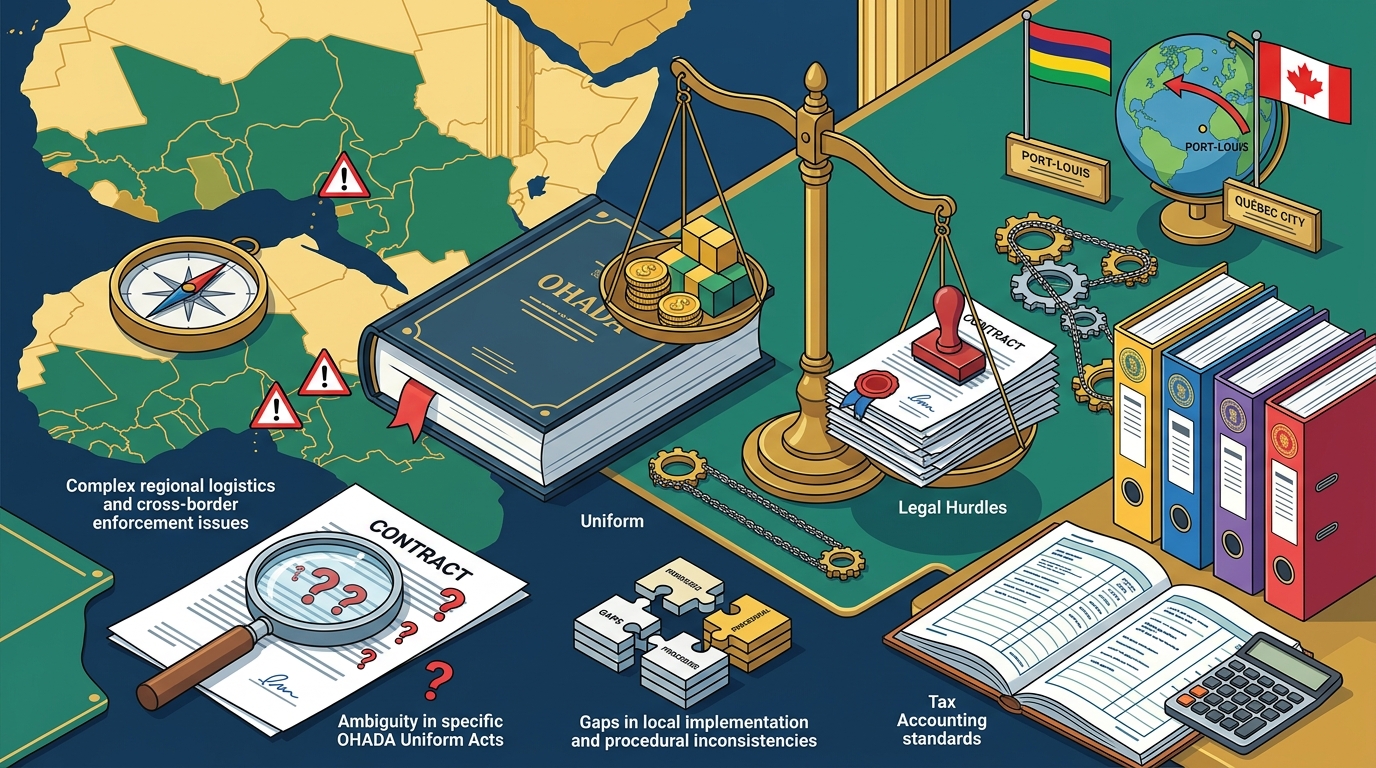
OHADA was established by a treaty signed on 17 October 1993 in Port-Louis, Mauritius, and later revised in Québec, Canada, on 17 October 2008. Its 17 member states include Benin, Burkina Faso, Cameroon, Central African Republic, Chad, Comoros, Congo, Côte d'Ivoire, the Democratic Republic of Congo, Equatorial Guinea, Gabon, Guinea, Guinea-Bissau, Mali, Niger, Senegal, and Togo.
OHADA's mission is to harmonize business law in order to guarantee legal and judicial security for investors and companies in its member states. The system comprises the OHADA Treaty and a series of Uniform Acts—currently eleven—that cover areas such as general commercial law, commercial companies, security interests, arbitration, mediation, accounting, insolvency, cooperatives, and goods carriage by road.
The Common Court of Justice and Arbitration (CCJA), based in Abidjan, Côte d'Ivoire, serves as the court of last resort for all matters governed by the Uniform Acts. Its decisions and arbitral awards are directly enforceable across every member state, even where they conflict with domestic law.
1. The FDI Gap in the OHADA Treaty
Perhaps the most fundamental legal challenge is structural: foreign direct investment is not directly regulated by the OHADA Treaty itself. While the preamble declares that OHADA's purpose is to promote economic growth and encourage investment, Article 2's definition of business law does not explicitly include investment law. Investment-related activities are instead governed indirectly through the corporate law, commercial law, and security law Uniform Acts.
This omission means there is no single, harmonized investment code across all 17 member states. Each country maintains its own national investment code with different incentives, restrictions, and procedural requirements. For an investor operating across multiple OHADA jurisdictions—for instance, managing subsidiaries in Senegal, Côte d'Ivoire, and Cameroon simultaneously—this fragmentation reintroduces the very legal uncertainty that OHADA was created to eliminate.
Practical Impact
- Investors cannot rely solely on OHADA law when structuring an investment; they must also analyze each host country's national investment code.
- Tax incentives, foreign ownership limits, and sector-specific restrictions vary dramatically between member states.
- Legal counsel must be retained in every jurisdiction where the investment has a presence.
2. Overlapping Regulatory Layers
Foreign investors in the OHADA zone face a multi-layered regulatory environment. National regulations intersect with OHADA Uniform Acts. While corporate governance, commercial law, and insolvency fall under the OHADA framework, sector-specific regulations—mining, telecoms, energy, agriculture—remain governed by national law. Added to this is an additional layer of regulations from regional monetary and financial institutions, such as the West African Economic and Monetary Union (UEMOA) and the Economic Community of Central African States (CEMAC).
For example, in June 2023, the UEMOA Council of Ministers adopted a community mining code that adds yet another regulatory dimension on top of national mining codes and OHADA corporate law. Investors in the mining sector in Guinea, Mali, or Senegal must now reconcile at least three separate legal frameworks.
Common Pitfalls
- Assuming OHADA law comprehensively covers all commercial activities—it does not extend to tax, labour (pending a Uniform Act), or sector-specific licensing.
- Failing to track regulatory changes at the UEMOA/CEMAC level that may override or supplement national rules.
- Underestimating the cost and complexity of multi-jurisdictional compliance.
3. Judicial Insecurity and Court Delays
Legal and judicial insecurity were identified as the key impediments to economic development on the continent and were the primary motivation for OHADA's creation. Despite the harmonized legislative framework, the quality of judicial enforcement varies significantly from one member state to another. Domestic courts may not always provide sufficient protection for international investments.
In practice, investors frequently encounter:
- Inconsistent application of Uniform Acts by lower courts that may be unfamiliar with OHADA jurisprudence or that apply outdated national provisions.
- Lengthy proceedings—cases before national courts of first instance can take years, and appeals add further delay before a matter ever reaches the CCJA.
- Enforcement difficulties—even when a judgment or arbitral award is obtained, enforcing it against state entities or politically connected parties can be extremely challenging.
The CCJA provides a measure of consistency at the cassation level, but it is geographically distant from most litigants and its docket is heavily loaded.
4. Resource Nationalism and Legislative Volatility
Significant political and legislative changes have recently occurred across the OHADA zone, including reforms directly altering the legal framework of mining activities in Niger, Mali, Burkina Faso, and Cameroon. Resource nationalism has been particularly pronounced in Mali, where changes include increased optional state participation levels in mining projects, the elimination of investors' ability to select the most favourable tax provision, and the end of tax exemptions on petroleum products granted during the production phase.
For investors in capital-intensive, long-term projects, this kind of mid-stream legislative change represents one of the most serious risks. A concession negotiated under one set of fiscal terms may suddenly become unviable when a new government adjusts royalties or requires higher state equity participation.
Red Flags to Monitor
- Election cycles—incoming governments frequently seek to readjust the balance of revenues in favour of the state.
- Draft legislation on increased state participation or new royalty regimes.
- Executive decrees that reinterpret existing mining or energy codes.
5. Local Content Requirements
New laws on local content in the mining sector have been introduced in Senegal, Mali, and Guinea. Although the concept of local content is not new, the increasing reliance on it and the novelty of the mechanisms in place require extra attention from investors who might need local assistance to understand the practical implications.
Local content obligations typically require investors to:
- Prioritise local suppliers and subcontractors.
- Meet minimum thresholds for local employment, including at managerial levels.
- Invest in training programmes and technology transfer.
- Establish joint ventures with local partners holding a minimum equity stake.
Non-compliance can result in fines, suspension of permits, or even revocation of operating licences. For investors accustomed to lean, centralised supply chains, these requirements impose significant cost and operational complexity.
6. Capital Repatriation Restrictions
A majority of African economies have volatile currencies, and to protect them, governments sometimes institute laws that create barriers for capital repatriation. An inability to repatriate funds to investors has a direct impact on whether an investment happens in the first place.
Within the OHADA zone, UEMOA and CEMAC each operate a shared currency (the CFA franc), which provides some exchange-rate stability. However, foreign exchange regulations still impose procedural burdens:
- Transfer approvals from central banks may be required for large outflows.
- Profit repatriation often requires proof that all local tax obligations have been satisfied.
- Currency controls may be tightened unpredictably during periods of macroeconomic stress.
7. Corruption and Bureaucratic Inefficiency
Challenges such as inefficiency and corruption within the judicial process have been reported across multiple OHADA jurisdictions. Bureaucratic inefficiencies affecting business operations—from company registration to permit acquisition—remain a persistent concern.
Complaints have highlighted instances of high-level corruption and occasional failures to honour foreign investment contracts, which may indirectly affect the investment climate. For investors subject to extraterritorial anti-corruption legislation such as the U.S. Foreign Corrupt Practices Act (FCPA) or the UK Bribery Act, navigating these environments without exposure is a constant legal challenge.
Mitigation Strategies
- Implement robust compliance programmes with third-party due diligence.
- Use OHADA-compliant corporate structures that include independent auditors.
- Engage reputable local counsel who can interface with administrative authorities transparently.
8. Dispute Resolution: CCJA Arbitration vs. National Courts
OHADA provides a sophisticated arbitration framework. The CCJA administers arbitration under its own rules, and arbitral awards rendered under CCJA auspices are directly enforceable across all 17 member states. This is a powerful advantage for cross-border investors. Additionally, the Uniform Act on Mediation, adopted in November 2017, provides a complementary mechanism for amicable dispute settlement.
However, several practical challenges persist:
- Cost: CCJA arbitration can be prohibitively expensive for small and medium-sized disputes.
- Enforcement against states: While awards are theoretically enforceable, executing against a sovereign state's assets within its own territory remains politically and legally complex.
- National court interference: Some domestic courts have been known to interfere with arbitration proceedings or refuse to enforce awards, despite the Uniform Act's clear provisions.
- Lack of specialised commercial courts: Most OHADA countries do not have dedicated commercial chambers, meaning complex business disputes are heard by generalist judges.
Investors should always include carefully drafted arbitration clauses in their contracts—specifying CCJA arbitration or another recognised institution—and ensure they comply with all procedural requirements to avoid jurisdictional challenges.
9. Bilateral Investment Treaties and Structural Planning
Investor protection ultimately relies on the investment treaties to which each host state is a party, combined with domestic investment laws. Investors should try to ensure that the ownership structure of their investment brings a bilateral investment treaty (BIT) into play. Neither OHADA nor its individual member states offer model BITs, but many OHADA zone states maintain networks of BITs with states that frequently appear in the ownership structures of international investments.
Practical structuring considerations include:
- Routing investment through a holding company in a jurisdiction that has a BIT with the target OHADA member state.
- Ensuring the investment qualifies as a protected investment under the relevant treaty—meeting requirements for substantial commitment of capital, assumption of risk, and contribution to the host state's development.
- Documenting the investment thoroughly to support a future treaty claim if necessary.
10. The Imperative of On-the-Ground Due Diligence
Foreign investors must be on the ground to conduct proper due diligence. Conducting due diligence virtually on an African entity does not produce accurate results. It is also advisable to secure assistance from local advisors in order to effectively understand the bureaucracy and regulations.
Key due diligence areas specific to the OHADA zone include:
- Corporate registry verification: Confirm that target entities are properly registered under the OHADA Uniform Act on General Commercial Law and that their RCCM (Registre du Commerce et du Crédit Mobilier) filings are current.
- Land title verification: Land tenure systems vary enormously between OHADA states; some still rely on customary tenure that is not formally registered.
- Regulatory licence audit: Confirm that all sector-specific permits are valid and transferable.
- Litigation searches: Check for pending proceedings before both national courts and the CCJA.
- Tax compliance review: Verify that the target entity has no outstanding tax liabilities that could trigger liens or penalties post-acquisition.
Key Takeaways
- OHADA does not include a Uniform Act on investment. Foreign investment protection depends on a patchwork of national investment codes and bilateral investment treaties.
- Regulatory complexity is multi-layered. Investors must comply with OHADA Uniform Acts, national sector-specific laws, and regional rules from UEMOA or CEMAC simultaneously.
- Judicial enforcement remains inconsistent. Lower courts may misapply OHADA law, and enforcement against state entities is difficult.
- Resource nationalism is accelerating. Legislative changes in Mali, Niger, and Burkina Faso have significantly altered fiscal terms for mining and extractive investors.
- Local content laws are tightening. Senegal, Mali, and Guinea now impose detailed local procurement, employment, and equity-sharing obligations.
- Arbitration is the preferred dispute mechanism—but it is not immune to enforcement challenges, especially against sovereign parties.
- Structural planning through BITs is essential for unlocking treaty-based protections, including access to international arbitration under ICSID or UNCITRAL rules.
- On-the-ground due diligence is non-negotiable. Virtual assessments are insufficient in OHADA jurisdictions.
Frequently Asked Questions
Does OHADA law directly protect foreign investors?
Not directly. While OHADA's preamble mentions encouraging investment, the Treaty does not include a dedicated Uniform Act on foreign investment. Investor protection comes from national investment codes and bilateral investment treaties, supplemented by OHADA's corporate, commercial, and arbitration frameworks.
How many countries are in the OHADA zone?
OHADA currently has 17 member states: Benin, Burkina Faso, Cameroon, Central African Republic, Chad, Comoros, Congo, Côte d'Ivoire, Democratic Republic of Congo, Equatorial Guinea, Gabon, Guinea, Guinea-Bissau, Mali, Niger, Senegal, and Togo.
What is the CCJA and how does it help investors?
The Common Court of Justice and Arbitration (CCJA) is OHADA's supranational court based in Abidjan, Côte d'Ivoire. It acts as the court of last resort for all proceedings under the Uniform Acts and administers arbitration. Its decisions and arbitral awards are directly enforceable in all 17 member states.
What is resource nationalism and how does it affect OHADA investments?
Resource nationalism refers to governments increasing state control over natural resources—through higher royalties, mandatory state equity participation, or revocation of tax incentives. Countries like Mali, Niger, and Burkina Faso have recently enacted such measures, significantly affecting the profitability and legal certainty of mining and extractive investments.
Can I enforce an arbitral award across all OHADA countries?
Yes, in principle. Arbitral awards rendered under CCJA arbitration are directly enforceable in all OHADA member states. Awards rendered under other arbitral institutions can also be enforced under the OHADA Uniform Act on Arbitration, subject to obtaining an exequatur from the competent national court.
What role do bilateral investment treaties play in the OHADA zone?
BITs provide substantive protections—such as fair and equitable treatment, protection against expropriation, and free transfer of funds—that are not available under OHADA law alone. Many OHADA states have signed BITs with European, North American, and Asian countries. Investors should structure their ownership to benefit from an applicable BIT.
Is it necessary to hire local counsel in OHADA jurisdictions?
Absolutely. Despite the harmonized OHADA framework, national laws still govern taxation, labour, land, mining, and sector-specific licensing. Local counsel is essential for navigating bureaucratic processes, conducting due diligence, and ensuring compliance with both OHADA and national requirements.